One of the most dramatic demonstrations of the power of the tides is found in the Western Passage of the Passamaquoddy Bay towards the mouth of the Bay of Fundy. “Old Sow” is the largest whirlpool in the western hemisphere, the second largest in the world – second only to the Maelstrom Whirlpool of Norway.
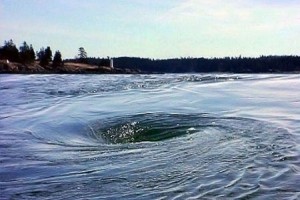
Old Sow Whirlpool can be seen from the shores just off the southwestern tip of Deer Island, New Brunswick, toward Eastport, Maine, on the incoming tide; however, on the outgoing tide it occurs (and is generally less pronounced) to the south of Deer Island, near Indian Island, NB.
This powerful whirlpool is formed when the rising tide passes both sides of Indian Island, takes a sharp right turn around the southern tip of Deer Island to flood the Western Passage. A current of over 6 knots (11 km/hr or 6.9 mi/hr) has been experienced off Deer Island Point. In addition to the waters pressing through the narrow straight, the waters are forced along the peaks and valleys of the ocean floor – a trench as deep as 122 meters (400 feet), followed by a reduction in water depth to 36 meters (119 feet) and again followed by a depth of over 107 meters (350 feet). The current of inflowing tributaries within the Passamaquoddy Bay add to the already busy waters.
Old Sow gets its name, not from the sound, but (although the origin of the name is unknown) most likely from the word “sough” (pronounced “suff”). The meaning of sough is: a type of drain or a sucking sound. It is plausible that, long ago, people referred in writing to the whirlpool as a sough, and those not familiar with the word, but familiar with “plough,” mispronounced it as “sow” rather than “suff,” and the name stuck.
What is the Best Time to See Old Sow?
Old Sow is reported to be most active about 3 hours before high tide. This activity continues for about two hours and takes the form of a collection of small gyres, troughs, spouts and holes and on the rare occasion will form one large funnel. This area, which has been reported to be as wide as 76 meters (250 feet) in diameter, can best be described as turbulent water. However, during spring tides (high water tide caused by a full or new moon) combined with high winds or a tidal surge will increase Old Sow’s activity causing more intense funnels and formations.
Additional Reading:
It’ll Thrill Ya, It’ll Kill Ya – Wired.co
Michael
we have been researching and it seems like there is some sort of sea monster
Anita
There is also a whirlpool at Thomas’ Cove in Economy NS. Have not seen it, but lobster fishermen have spoken of it in the past.
teddy bear
I am glad to know that
teddy bear
thank you
Dave Rolston
The picture doesn’t do it justice. At full tidal flows (esp half-tide dropping) that teeny whirlpool in that pic is like 1km across. In the mid-late 1980s I was on the CCGS Tupper and the skipper took that 1900 ton 205ft boat thru – and we were spun around 3 times and there was nothing we could do – and then she spit us out
!23
Thanks for helping with my slides.
Greg Lenz
I’ve seen the rocks at the Bay of Fundy, I missed, ignorance, the old Sow.
James Fair
We have some of these whirlpools off the coast of BC. My Dad told about the time in the early forties when he, his brother, and my Aunt got caught in one, in a motor boat, went round and round with the stern down and the bow high, little outboard engine screaming, and my Aunt screaming. Dad said you could hear the sucking noise over the engine noise, and see big stumps and logs going around down in the throat, and they just barely got away. These things open up unexpectedly, and how would they know? They were from Saskatchewan! They were working for a logging outfit at Redonda Island.
MiseMeFein
We went through this in a tall ship in 2003, as an alternative navigational route than the rapids we shot to get into St. Andrews, which was the closest call with doom in a life of sailing.
Michele
There’s one of the S or SE coast of Campobello Island as well. Sometimes if the tide is particulatly strong, that one can get big and it can be heard quite a distance before you see it. I wouldn’t want to go too close to it, but in the day and age of drones, I’d love to see some of these whirlpools from above!
Rob vanNostrand
Burntcoat Head in Nova Scotia has one of these too. I was sailing just off the lighthouse island a few years ago and noticed it. After observing it for a while and motoring near it, I decided to motor through it to see what happens. Now I am living in another dimension… (just kidding), no harm was done. 🙂
Sol
*Adding this to my “Places NOT to go diving” list*
Rose Fuller
My husband and I had the privilege of going to Deer Island last summer. I might add that we have lived in N.B. our whole lives and had never taken the time to go. We were so amazed that when relatives from B.C. visited in the fall we returned. They could not stop talking about the free ferry ride and the beautiful scenery. What an amazing part of the country we live in.
Joyce Turco
That whole area is fascinating, we went there to see the Old Sow but it was 3:00 am and I was too tired to see it. Now I need to go back so I can hopefully see it. There are so many things there to see, including the Cabot Trail. Canada is a beautiful country. One of my grandmothers came from Cape Breton, NS.
Sow Chaser
I didn’t know there was so much to see in the area: Lighthouses, Campobello, Whale Watching, Puffins, Old Sow, and other tidal phenomena! Truly amazing! Hoping to visit soon…it’s been way too long, and I missed so much!
Jeffrey W. Judkins
If a person, boat, debris, etc. gets sucked down into the hole; where does it end up?
Sow Chaser
Unlike a true black hole which we can only theorize, here more buoyant objects pulled down into the vortex would, sooner or later, pop back up at the surface…possibly strewn a significant distance from the vortex. Less buoyant objects would be more at risk to being lost under the waves under its own weight or possibly pinned down by undercurrents. If lucky, these objects may be set free and re-appear later at the surface.
Leigh Zima
Thank you for helping me with my school report
Bay of Fundy
Glad to hear you found the website useful.
Sally
Hi Mike:
Are you still answering queries on this site? And do you live/know much about the St. Andrews area? Am tentatively planning a trip to that locale and surrounding areas.
Thanks.
Jim Farrell
I remember in the mid 1950’s my father and a few others sailed from N.S. to Boston on a large motor cruiser,and hearing them tell of travelling along the edge of this and being able to look down into it.
Robert Godfrey
Old Sow Whirlpool is typically seen located just off the southwestern tip of Deer Island, New Brunswick, toward Eastport, Maine, on the incoming tide; however, on the outgoing tide it occurs (and is generally less pronounced) to the south of Deer Island, near Indian Island, NB.
Old Sow gets its name, not from the sound, but (although the origin of the name is unknown) most likely from the word “sough” (pronounced “suff”). The meaning of sough is: a type of drain or a sucking sound. It is plausible that, long ago, people referred in writing to the whirlpool as a sough, and those not familiar with the word, but familiar with “plough,” mispronounced it as “sow” rather than “suff,” and the name stuck.
Bay of Fundy
Thanks for taking the time to share this Robert. Would you mind if I included your comment in the main copy above?
Robert Godfrey
Please do, Mike.
Nice
that kind of gave me the chills..